The four specs that decide a legal case
Does letter-size paper go in flat?This is the gate, and more cases fail it than you would expect. A bag designed around a 13-inch laptop is about 13.5 inches wide, and a letter-size file in a folder is 9 inches by 11.75 inches — it fits, but only in one orientation and only if the interior is not divided by a laptop sleeve running the wrong way. Every pick here takes letter paper flat; two of them publish the exact pad footprint.
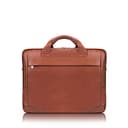
Does it stand up?A soft-sided satchel collapses when you set it on a courtroom floor or a client’s table, and then you are holding it open with one hand while you look for something. A structured case keeps its mouth open. This is the single biggest practical difference between the McKlein and the cheaper soft satchels on the hub, and it is the reason the slimmer case ranks above the roomier ones here.
What does the listing say about the hide?Two of the five state a grade — one top-grain, one full-grain. One publishes nothing. One contradicts itself between its title and its bullets, which on this site means its grade field is published as nothing and the contradiction gets printed instead of resolved in the seller’s favor. The vocabulary is in full-grain vs. top-grain leather, and the reason the distinction is worth caring about on a case you carry daily is in is full-grain leather worth it.
Is there a stated warranty? Exactly one of the five publishes one, and it is a folio rather than a briefcase. That is a pattern we have found across this whole hub and reported before: the listings that name their hide usually do not name a warranty, and the one that names a warranty will not settle its grade.
The five, side by side
Every cell is read from the listing or marked “Not published.” No cell is inferred from a photograph.
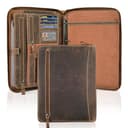
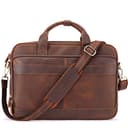
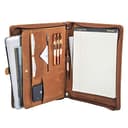
| | McKlein Montclare | LEATHER VILLAGE folio | Samsonite toploader | Jack&Chris | Gavarnie folio |
|---|
| Format | Structured briefcase | Four-ring folio | Structured toploader | Attaché-style briefcase | Zip-around folio |
|---|
| Grade as stated | Top-grain calfskin | Full-grain | Not published | Full-grain | Not published (title and bullet disagree) |
|---|
| Laptop fit as stated | 13 in + tablet | Tablets to 13 in | Not published as a figure | Laptop compartment, no figure | Up to 13.3 in |
|---|
| Dimensions published | No | 13 x 10 x 1 in | No | No | 14.8 x 10.8 x 1 in; 1.98 lb |
|---|
| Closure / hardware named | Not published | YKK zip; removable 1 in 4-ring | Not published | Not published | Dual YKK zip |
|---|
| Warranty stated | Not published | Not published | Not published | Not published | 1 year replacement |
|---|
| Best read as | One case for everything | A tabbed file you can reorder | A brand that fixes bags | The grade pick | Court day without a briefcase |
|---|
Read the “dimensions published” row against the “grade as stated” row. The two folios publish real numbers — footprint, depth, weight — and the three briefcases publish almost nothing beyond a laptop size. That is a category habit rather than a quality signal, but if you are deciding whether a specific set of files will fit, the folios are the only two entries on this page that let you check before buying rather than after.
Briefcase, folio, or both
The practical pattern for most legal work is a case for the commute and a folio for the room. The briefcase carries the laptop, the chargers and the files between office and court; the folio is what goes to the table, because a folio opens flat, holds a legal pad and keeps a tabbed set in order without the rest of your day spilling out of it. If you are only buying one thing this year and you already own a serviceable bag, buy the folio — that is the purchase that changes a day.
If you are buying the one case, buy structure over volume. A slim structured briefcase that stands open is more useful than a larger soft satchel, because the moment that costs you time is not loading at home, it is finding something in front of a judge or a client. The formality comparison — and the case for a backpack when you walk to work — is in backpack vs. briefcase for work, and the messenger alternative is weighed in messenger bag vs. briefcase.
What a legal case does not need is maximum capacity. The heaviest thing most lawyers carry is paper, and paper is dense: a case big enough to hold everything is a case you will fill and then regret on a flight of courthouse steps. Our what to look for in a leather briefcase guide makes the same argument at length.
Cost, and what the bands actually buy
Every price on this page comes from the live price layer with the date it was read, so we do not type figures into the prose. What the bands buy is covered properly in how much a leather briefcase costs, and the finding there applies squarely here: in this category the money goes into labor and structure rather than into a thicker hide, and the premium band does not reliably buy a better-disclosed leather. The most expensive pick on this page is the one that will not settle its own grade.
Care is simple and matters more than it does on a bag that lives in a car. Keep it out of direct heat, do not store it under load, and clean before you condition — the routine is in how to care for a leather briefcase. A stated full-grain or top-grain case will darken at the handles and corners over the first couple of years; that is patina rather than wear.
One last note on how we work: we do not own any of these cases, so nothing above is a durability result. It is a comparison of what five listings publish, plus an argument about which of those facts legal carry actually tests — the full version is on our methodology page.