What each listing actually claims
Every cell below is read from the listing, or marked “Not published.” Read the first two columns together: a product can state where the leather was tanned, or where the item was made, or both, or neither — and the price does not reliably follow.
| Pick | What “Italian” refers to | Country of manufacture | Grade stated | Tannage stated |
|---|
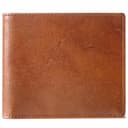
| ALBEPPE bifold | A named Tuscan tannery plus a consortium certificate | Not published | Full-grain | Vegetable-tanned |
|---|
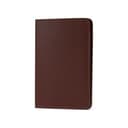
| Maruse passport cover | The workshop - handmade in Italy | Italy | Top-grain calf | Not published |
|---|
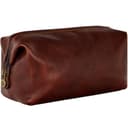
| Time Resistance dopp kit | The workshop - handmade in Italy | Italy | Full-grain | Vegetable-tanned |
|---|
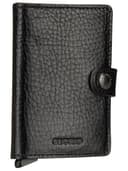
| SECRID Miniwallet | The production countries | Italy and Holland | Not published | Vegetable-tanned |
|---|
| WOLFANT belt | The hide's origin only | Not published | Full-grain | Not published |
|---|
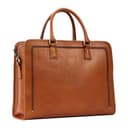
| Banuce briefcase | The hide's origin only | Not published | Full-grain | Not published |
|---|
The two rows worth arguing about are the last two. WOLFANT and Banuce both say “Italian full grain leather,” which is a claim about the hide and says nothing about where anything was cut, stitched or finished. That is not a lie and it is not nothing — a tanned-in-Italy hide is a real supply-chain fact, and Italy has one of the oldest tanning industries in the world. It is simply a smaller claim than the sentence looks like.
The four things “Italian” can mean
Ranked by how much a seller is risking when they write it.
- A named tannery, with a certificate. The strongest version, and the rarest. The ALBEPPE listing names Conceria Monteverdi and says each wallet carries a numbered certificate from the Italian vegetable-tanned leather consortium — a trade body whose whole function is to put a mark on genuine Tuscan vegetable-tanned leather. A serial number is checkable, so this is the one claim on the page that could be disproved.
- Made in Italy, stated outright. Maruse says handmade in Italy; Time Resistance says handmade in Italy; SECRID names Italy and Holland as its production countries. A country of manufacture is a meaningful claim and a real cost, because Italian labor is not cheap. Note that none of the three names the tannery — made in Italy and tanned in Italy are separate facts, and a listing can have one without the other.
- Italian leather, meaning the hide. WOLFANT, Banuce and several other listings we read use the phrase this way. It describes the raw material’s origin and leaves the assembly country unstated. Treat it as a hide-origin claim, not as provenance for the finished object.
- Italian as a mood. A title that reads “Italian style,” “Italian design” or just an Italian-sounding brand name invented for the listing. There is nothing here to check, and we included none of them. If the only Italian thing in a listing is the brand name, you are paying for a font.
How we chose
Three filters, applied in order, which is why the list is six items across five product categories rather than six wallets.
First, the listing has to use the word in a checkable way.A tannery, a consortium certificate, or a stated country of manufacture all qualify. “Italian design” does not. That filter alone removed most of what a search for Italian leather returns.
Second, the grade and the tannage are read separately.This is the site’s standing rule and it matters doubly here, because Italy is famous for vegetable tanning and buyers read “Italian” as though it implied the tannage. It does not. Three of these six state a grade and no tannage; one states a tannage and no grade. If both matter to you, only two picks here give you both — the ALBEPPE and the Time Resistance. The difference the tannage makes is in vegetable-tanned vs. chrome-tanned leather, and the difference the grade makes is in full-grain vs. top-grain.
Third, one pick per category. A list of six Italian bifolds would be a worse answer to the question than a wallet, a passport cover, a dopp kit, a card wallet, a belt and a briefcase, because the thing you are choosing is a provenance standard, not a format. Where a format has a better-documented Italian option that is not here, it is because we already cover it elsewhere: the HISCOW card holder states full-grain Italian vegetable-tanned oil leather and sits on our vegetable-tanned wallet roundup, and the Crazy Horse Craft and Polare pilot wallets both make Italian-hide claims on our passport holder roundup.
What Italian provenance is and is not worth paying for
It is worth paying for when it is attached to something else. A named Tuscan tannery is useful because vegetable tanning is a slow process with a consortium behind it, and that process is what produces leather that darkens into a patina instead of wearing pale. A stated country of manufacture is useful because it tells you who is accountable for the stitching, and stitching is what actually fails first on a leather good. In both cases the Italian part is a proxy for a specific production fact.
It is not worth paying for on its own. A hide tanned in Italy can be assembled anywhere by anyone, and a split, corrected hide tanned in Italy is still a split, corrected hide. If a listing offers you “Italian leather” and refuses to name a grade, the sentence you are being sold is doing less work than it appears to. Our guide to telling real leather from fake covers what you can check once the thing is in your hands, and bonded leathercovers the floor of the category — which is where an unqualified claim can sit.
One practical note on price. Of these six, the two with the strongest disclosure are not the two most expensive, and the most expensive is not the one with the most claims behind it. That inversion is normal in this category and it is the single best argument for reading the listing rather than the number. Prices on this page come from our live price layer with the date they were last checked, so you can see the current spread yourself.
Caring for it once it arrives
Three of these six state a vegetable tannage, and veg-tan asks for a different routine than a pigmented chrome-tanned finish: less product, more often, and real caution with water, because a lightly finished hide water-marks easily. The method is in how to care for vegetable-tanned leather, and the general cadence is in how often to condition leather. The short version: a stated full-grain, vegetable-tanned Italian hide is the one kind of leather where doing nothing for the first year is the correct move.
As always: we have not handled any of these items. Every claim above is read from the live listing on the date printed on each card, and the reasoning behind that method is on our methodology page.